
The 1970’s, not so long ago, was a dark period of history for the people of Cambodia. Between 1975 and 1979, over 3 million of the 8 million people living in Cambodia were killed…some starved to death, others worked to death, over 1.5 million murdered in the killing fields. I’m not sure what the draw was to see this site of horrific suffering, pain and death, but I needed to experience it, to believe it happened, to maybe gain some sense of it.
Please know that this blog may be hard to read, some parts graphic. I will not be offended if you choose to skip this one. It will not be filled with pretty sights, beaches and palm trees, five star hotels, or palaces. It is dark, and I am not ashamed to say that tears rolled down my cheeks as I wrote this piece.
A little background….
On April 17, 1975, the Khmer Rouge marched into Phnom Penh. The arrival of the communist troops, mostly young and dour peasant boys hardened by years of guerrilla war, marked the end of a traumatic civil war. At first the residents of the city cheered and celebrated the arrival of the troops, but within three days every man, woman and child of the city were forced out of their homes and marched into the countryside during some of the hottest days of the year, to be placed on agricultural cooperatives. Hospitals shut down, businesses all closed, schools boarded up…the capital city became a ghost town, and it commenced the beginning of a nearly four-year long nightmare of ultra-Maoist rule.

S-21
On a dusty road on the outskirts of Phnom Phen sat Tuol Svay Pray High School. A building once bustling with young minds gaining an education. You can still hear their laughter, their hopes and dreams of a better life. A high school like anywhere else in the world, filled with those goofy young adults. But in 1975 the Khmer Rouge confiscated the school, renamed it S-21 (Tuol Sleng Prison) and turned it into a torture, interrogation and execution center. Of the 14,000 who entered this prison, only 7 survived.
Here is where innocent people were brought and tortured into confessions, confessions that held a death sentence. Like in Nazi Germany, each prisoner was carefully photographed and documented. Room after room at this school now holds pictures of the victims…hundreds of them, thousands of them. There are too many to comprehend. You choose one and look into their eyes….you crawl into their head and feel the pain, the fear, the resignation that death awaits you very soon. It is difficult to hold the gaze, and you choose another to visit with. You bow your head and suffer with them. You question the human race, how could this happen? These are modern times, a short 40 years ago. You are ashamed. You are impotent to help. You cannot change what happened.


Men, women and children…all treated the same. Shackled to beds, crammed into cells, treated in the most inhumane manner possible. You can still see the blood stains on the floor, no amount of bleach can erase. The poles are still there where prisoners were lifted up off the ground by their hands tied behind their backs. The big pots still stand, once filled with putrid water where they lowered people head first until they drowned or confessed. The clamps are visible where arms were immobilized while fingers were cut off. And you look at the faces of the people again and you cry.
-
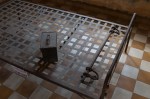
- Metal bedframe to which prisoners were shackled and tortured.
-
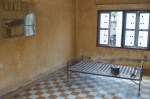
- Inside each room hung large pictures with actual victims…pools of blood under the beds. Horrific.
-
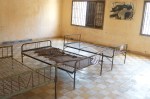
- More beds, more suffering.
-
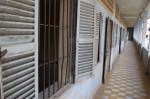
- Bars were added to all the windows.
-
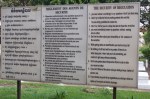
- Rules of the camp.
-
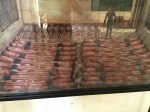
- A picture showing what many of the rooms looked like….people, in rags or naked, hands tied behind their backs, legs in irons. Left with no food, no water. Left until it was time to question them.
-
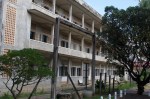
- The poles once held climbing ropes for the high school students, now they lifted up prisoners by their arms tied behind their backs.
-
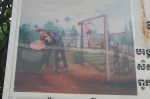
- Picture of prisoner being lifted up and another being dunked in water.
-
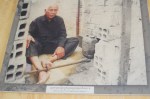
- Photo of a picture showing a survivor demonstrating the leg irons.
-
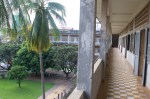
- Three floors of rooms, five buildings of rooms.
-
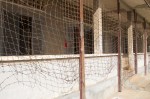
- Wire covered the entrances and hallways.
-

- Razor sharp…no one escaped.
-

- So many cells, a place to wait before you die.
-

- Cell about 4 feet by 5 feet. Ankles were locked into iron shackles.
-

- Simple cells made from brick and mortar…prisoners chained inside. Holes chopped through the concrete walls to connect the rooms.
Survivor
As I left S-21, I met a gentle, soft spoken man, Chum Mey. He was one of seven people who survived the camp. He survived because the Khmer Rouge found he could fix typewriters…they needed him so they could continue to type up the confessions. He is 84 years old now and makes his living selling his memoirs. I spoke to him for a bit, through an interpreter. He somehow has found a sense of peace with his life and all that happened to him. Tears still flow when he remembers. He was one of the lucky ones. We hugged and he helped me heal a bit.


Choeung Ek Killing Fields
Choeung Ek was but one of over 300 killing centers. The prisoners at S-21, after confessions were gained, were brought here to die. Each evening, prisoners at S-21 were handcuffed, blindfolded and herded into trucks…told they were being moved to another location. Instead they were brought to Choeung Ek, formerly a fruit orchard. The prisoners were led blindfolded, tethered to the person in front of them by a rope around their neck, to pits freshly dug that day. One at a time they were brought to the pit and made to kneel a meter away from the edge. Bullets were too valuable to use, so instead simple farm instruments…hammers, picks, shovels, cart axles, etc. were used to crush skulls or break necks. The bodies were shoved into the pits, handcuffs removed…and one by one the hole filled with the dead and dying. When all met their fate, they were covered with DDT to kill anyone still alive and to keep the smell down. By morning the pits were covered with dirt and new ones dug.


Over 20,000 people met their fate here at Choeung Ek. It is a somber place, a place of compassion, of memory. Bracelets are left here. Not sure who started this act, but on the bamboo barriers, on trees, on signs…bracelets have been left. To say what? Does it speak to the dead that we give a bit of ourselves, in solidarity. Is that friendship bracelet saying, “You could have been my friend.” Perhaps it is just to say, “You are in my thoughts…I will remember you…I will work to make sure this doesn’t happen again.”

Over 8,895 bodies have been unearthed at Choeung Ek. The bones and skulls lovingly cleaned and now lie in a large glass Buddhist stupa. The skulls look out over the fields and keep watch. They cry out to you, “Why?” It is a tribute to those who lost their lives and a grim reminder of what happened here, here in the killing fields.
-
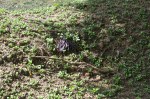
- After a rain, clothing, bones, teeth come up to the surface. Note the piece of clothing in the pit. They are collected and added to the collection.
-
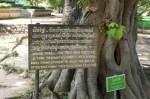
- The magic tree created the last sounds the prisoners heard before dying.
-
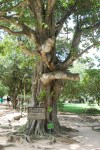
- Nothing magic about the magic tree….loudspeakers were hung to cover the sounds of the dying and to make the outside world think there were just political rallies occurring on the property.
-

- Collection of bones that keep coming up.
-
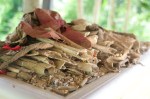
- Collection of bones and teeth.
-
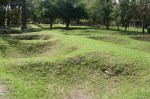
- Pits of those exhumed.
-
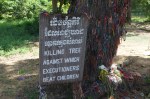
- So, so sad. The Killing Tree…where children were killed while their mothers were forced to watch. They would swing the children by their legs crushing their skulls on impact.
-

- Collection of clothing still surfacing.
-
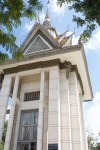
- The Buddhist Stupa to honor those who died.
-
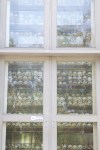
- The skull in the stupa look out over the killing fields…silent sentinals.
-

- Arranged by age.
-
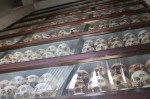
- layer upon layer of skulls.
-
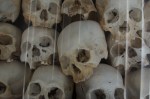
- Each was a person, with smiles and hopes and dreams.
-
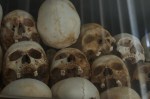
- maccabe for sure but you wonder what they would have become in their lives had they been able to live them out.
-
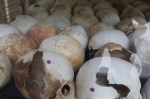
- Signs of the terrible deaths, of crushing blows to the head.
-
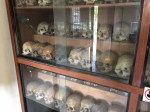
- 8,895 skulls reverently displayed.
Evening falls and I am back in Phnom Penh, sitting in a bar watching life go by. I hear laughter, people walking hand-in-hand, dancing to be had, food to be enjoyed. I drink a toast to those lives lost. I drink a toast to smarter, more compassionate days ahead. Cambodia has healed. I hope it never forgets.

 Our Adventures